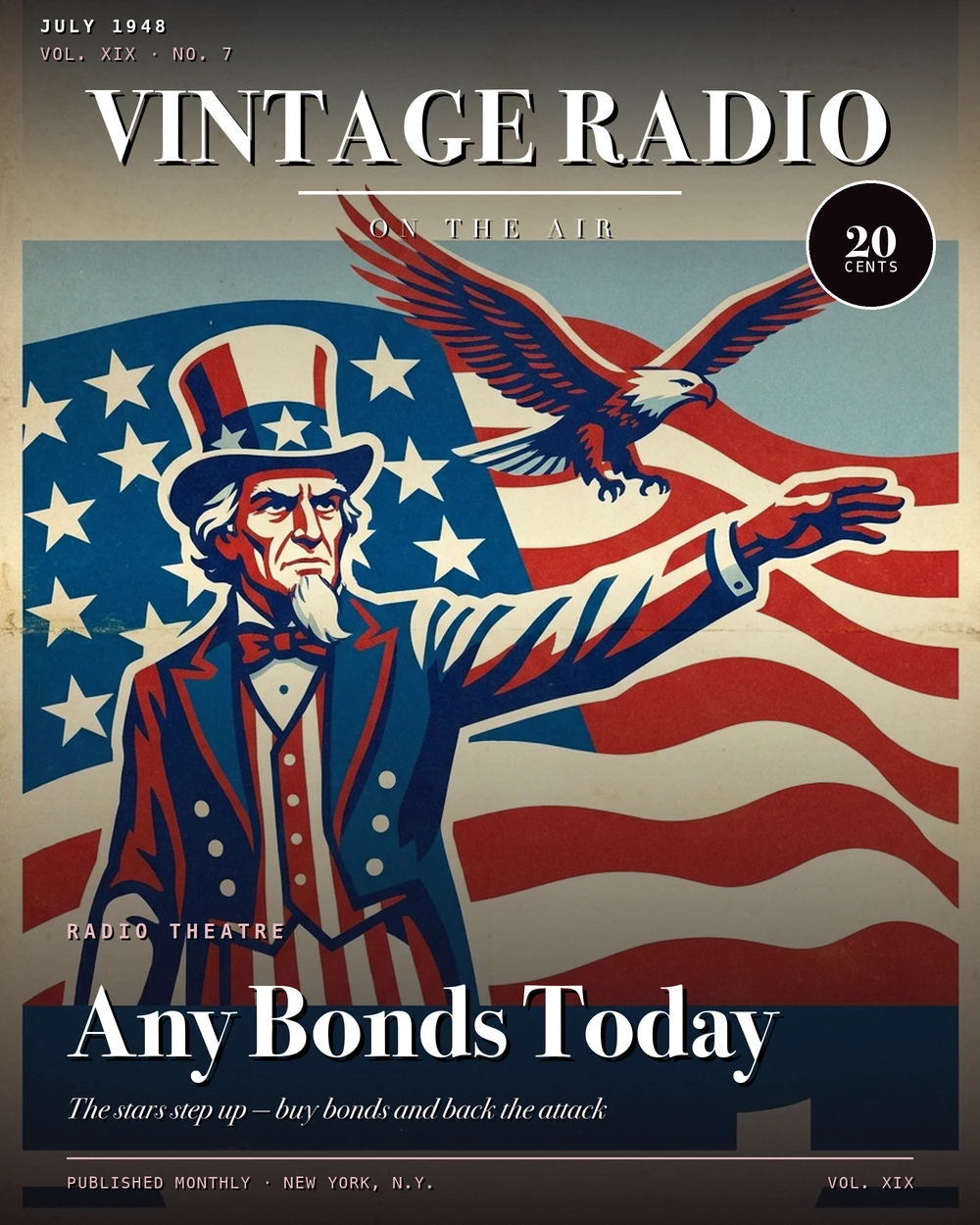
Any Bonds Today
Three Weeks, Five Episodes, One Purpose
The U.S. Treasury Department didn't waste time getting radio to work for the war effort. Any Bonds Today ran for exactly five episodes across three weeks in early 1942 — from February 4 to February 25 — and each 15-minute broadcast followed the same tight formula: one patriotic comedy or dramatic sketch, one patriotic musical performance, and a celebrity guest willing to put their name behind the bond drive. Short, purposeful, and direct.
The show's title came straight from Irving Berlin's 1941 song "Any Bonds Today?", written at the request of Treasury Secretary Henry Morgenthau Jr. and adopted as the official theme of the National Defense Savings Program. Berlin signed over his royalties from the song to the war bond drive — one of several wartime compositions for which he did the same.
The Guests and What They Did
The five episodes brought in a notable spread of talent from Hollywood and the concert stage. Fanny Brice — the comedian and singer who had been performing her Baby Snooks character on radio variety shows since 1937 — appeared on two of the five broadcasts. Ukrainian-born baritone Igor Gorin, one of the most recognized voices on American radio in that era from his work on The Voice of Firestone and The Bell Telephone Hour, shared one of those episodes with her.
Walter Pidgeon, the Canadian-American film actor then at the height of his popularity after How Green Was My Valley and on the verge of Mrs. Miniver, took another episode. Fay Wray and John Beale shared a broadcast, with Wray appearing as the Goddess of Liberty in a piece called "The Last Boat." Henry Fonda rounded out the guest roster in a sketch titled "The Man from Cemetery Ridge," described at the time as movingly dramatic. Not every sketch was solemn — the catalog also records a lighter comedy piece built around a character buying her first War Stamps.
What the Treasury Was Selling
The bond drives that programs like this supported ultimately raised $185.7 billion from 85 million Americans over the course of the war. Radio entertainment was one part of that machinery. The Treasury's pitch reached across income levels: War Stamps were available for as little as 10 cents apiece, collected in a special album that could eventually be traded for a Series E Bond. Workers were encouraged to put 10% of their earnings into bonds.
Any Bonds Today wasn't the first radio program the Treasury used for this purpose. An earlier and longer-running effort, Millions for Defense — later retitled The Treasury Hour — had been on CBS since mid-1941, using Berlin's song as its theme and featuring talent including Jack Benny, Fred Allen, and Bob Hope. That was a distinct program from this 1942 series, though they shared the same song and the same sponsor.
What Survives
All five episodes are in the catalog. That's the complete run — nothing is missing. As a production, Any Bonds Today was modest by design: 15 minutes, no elaborate ongoing cast, no continuing characters. It did exactly what it was built to do within a tight broadcast window, then stopped. The variety format — comedy and music wrapped around a clear message — kept the tone from becoming a lecture, which was the point.